What's the true cost of climate risk? A framework built with Soudah Development
How do you put a price on climate risk? Developed in collaboration with Soudah Development, this handbook sets out dss+'s practical, 11-step framework for translating physical climate hazards into a defensible Value at Risk (VaR), then prioritising and financing the adaptation measures that reduce exposure at the lowest cost. Applied to Soudah Development's mountain tourism destination in Saudi Arabia's Aseer region, it gives leadership a clear, evidence-based basis for prioritisation, investment and accountability.

Climate risk is no longer a distant concern – it’s a material business risk. For executive teams, the challenge is not recognizing the issue but determining how to cut through the noise and identify where it truly affects operations, assets, and long-term growth. Too often, climate risk assessments feel abstract, lack a clear approach, and leave leadership guessing.
Extreme weather events are already disrupting operations, insurance markets are offering less coverage at higher cost, and regulatory pressure is moving faster than many businesses anticipated. At the same time, climate models are becoming far more precise, revealing exposures that were invisible even a few years ago. Companies that rely on broad, qualitative assessments increasingly find themselves surprised by asset degradation, operational disruption and escalating recovery costs. Boards and investors are now asking harder questions: not just whether climate risk is understood, but whether it has been quantified in a way that guides capital allocation and operational planning.
This handbook offers a practical, stepwise approach to do exactly that. It provides a defensible calculation of financial exposure across assets and operations, translating physical hazards into clear Value at Risk (VaR) framework (the maximum potential financial loss due to exposure to risk). It shows where climate-driven failures are most likely, how severe they could be, and which interventions reduce exposure at the lowest cost. Instead of treating climate adaptation as an open-ended problem, this approach narrows decisions to the actions that matter most and gives leadership a clear basis for prioritization, investment, and accountability.
"Climate change is a strategic risk that should be managed with the same rigor and economic discipline than any other corporate risk."
The framework removes subjectivity and guesswork, giving you clarity and confidence to act., It consists of eleven steps: calculating VaR, prioritizing adaptation measures, and operationalizing chosen risk reduction actions. The phases and underlying steps are designed so that a decision can be made at each stage on whether it makes sense to progress to the next. Figure 1 summarizes the overall workflow.
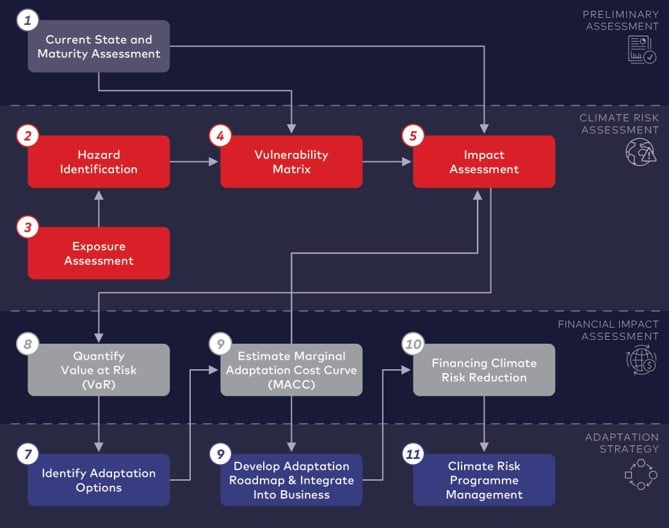
Figure 1: Climate Risk Workflow
This workflow lays out a clear progression: begin with foundational requirements, build a defensible view of risk, then prioritize and operationalize the most cost-effective actions.
To access the full content, please download the handbook here.